

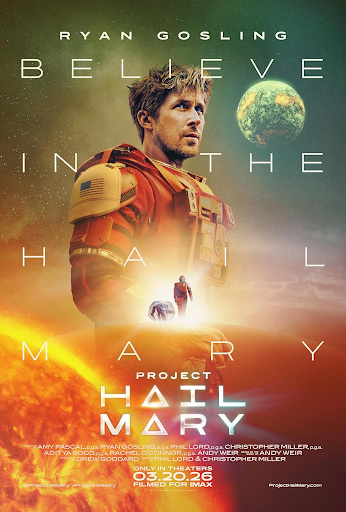
On March 20, 2026, the film adaptation of Andy Weir’s beloved science fiction novel “Project Hail Mary” was released, bringing the book’s science-driven survival story to the big screen. The story follows Ryland Grace, played by Ryan Gosling, a middle school science teacher who wakes up alone on a spacecraft with no recollection of how he got there. As his memories gradually return, he realizes he’s humanity’s last chance to prevent a global catastrophe.
The film tells this story through a mix of present-day survival scenes and flashbacks that gradually reveal how grace was chosen for the mission. Much of the tension comes from his isolation in deep space, where he must rely on his knowledge, creativity and logic—not only to to stay alive, but to solve a problem that even Earth’s top scientists could not address.
Senior Hannah Kim was particularly drawn to the story because of its premise and mystery elements.
“I hadn’t read the book but the idea of a person with amnesia stranded in space definitely draws in viewers who enjoy a good mystery and adventure,” Kim stated. “It’s definitely an interesting premise: trying to figure out who you are while simultaneously trying to save the planet.”
One of the most distinctive aspects of the story is its focus on scientific reasoning. Instead of treating science as a background detail, the plot builds around experimentation, equations and discovery. Each breakthrough leads to a new challenge, weaving the narrative through a chain of interconnected problems rather than the traditional space adventure that we all know and love such as “Star Wars,” “Guardians of the Galaxy” and “Armageddon,” which are very action-oriented.
Kim noted that the film adaptation brought about the perfect amounts of depth, complexity of plot and humor.
“I’d describe my reaction as being pretty hooked on the suspense without it feeling over-the-top,” Kim said. “It’s one of those stories that makes you feel the pressure of the situation, but it has enough humor to keep it from being too heavy.”
A pivotal moment in the film is when Grace makes contact with Rocky, a brilliant engineer from another planet known as Erid.
“The story becomes about two very different characters trying to figure each other out,” Kim explained. “It adds a very wholesome and human touch to the story. Despite being from two completely different worlds, the friendship that they share is genuine. It was very heartwarming to see the level of trust and banter between them.”
The film’s overall hopeful, humorous tone was refreshing for many viewers as it differed from similar projects such as “Interstellar” which was a lot more layered and complex.
“Compared to similar films I’ve seen recently, it’s much more optimistic and less ‘doom and gloom,’” Kim said. “It was nice to see a Sci-Fi film where characters actually like each other and collaborate to find a way out.”
Ultimately, “Project Hail Mary” works as both a survival narrative and an emotional journey about connection in the most unexpected circumstances. It explores common themes of resilience, problem solving and cooperation under extreme pressure. It also asks what it means to face the unknown alone and how far someone is willing to go when failure is not an option, leaving viewers with a deeper appreciation for science and the human drive to solve impossible problems.