

In recent years, conversations about filmmaking have increasingly highlighted cinematography, CGI and editing— yet a crucial element still slips under the radar: film score.The majority of people do not walk out of a movie theater talking about background music. Instead, they recall the plot, the acting or a dramatic scene. However, what often goes unnoticed is how much of that emotional impact is shaped by a film score.
A film score is much more than background noise: it’s carefully designed to guide the audience’s emotions, often without them realizing it. From the moment a scene begins, music has the power to signal whether something is hopeful, tense or tragic. Without it, many pivotal moments onscreen would feel incomplete. Fans recall the sharp, unsettling strings in “Jaws” that warn danger before the shark appears, or the warm piano theme in “Up” that softens an otherwise heartbreaking montage. Without these musical cues, many pivotal scenes would lose their emotional weight.
Senior Chaitra Jogiraju, a music student experienced in composition, reflects on the intentional music choices composers make behind the scenes.
“One of the first things I notice is how specific instruments are used and why,” Jogiraju said. “A full string orchestra, for example, can sound romantic in one moment and ominous in another depending on the mode, the harmony and the tempo.”
These choices are intentional and deeply rooted in music theory. Minor modes often create tension or unease, while major harmonies tend to evoke bright/ triumphant emotions. Slow tempos can make a moment feel heavy or reflective, whereas faster rhythms build urgency. Even instrumentation matters: a solo violin can feel poignant, while a full brass ensemble can overwhelm the audience with power. These decisions shape how viewers interpret a scene before a single line of dialogue is spoken.
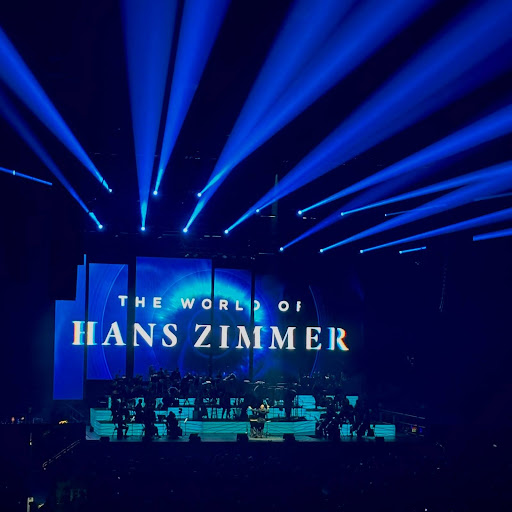
One of the most recognizable examples of this is the work of composers like Hans Zimmer and John Williams whose scores have become just as recognizable as the films themselves. In movies like “Inception” and “Interstellar,” the music builds intensity and emotion in a way that visuals alone cannot. The deep, resonant sounds in “Inception” create urgency, while the sweeping score in “Interstellar” evokes both isolation and wonder.
Film scores often rely on repetition and variation to leave a lasting impression. A technique known as a leitmotif ties a specific melody to a character, idea or relationship. As the story evolves, that theme may return in altered forms, reflecting changes in the narrative. This compositional approach helps audiences stay emotionally grounded even if they are not consciously tracking the music.
“Repeating themes makes the music memorable,” Jogiraju stated. “It’s subtle but keeps the audience connected.”
Recent films use leitmotifs in especially memorable ways. In “Dune,” Hans Zimmer assigns Paul Atreides a rising vocal motif that grows more forceful as his destiny becomes clearer. In “Black Panther,” Ludwig Goransson blends African percussion with a distinct talking-drum pattern tied to T’Challa, subtly reminding the audience of his presence even when he’s off-screen. These recurring themes help anchor the story emotionally, even for viewers who don’t consciously notice them.
Music also plays a major role in controlling pacing. Fast, driving rhythms heighten tension in action scenes, while silence or minimal sound can create discomfort or suspense. Ensemble choices often signal how intense a moment is meant to feel.
“In films like “Star Wars,” heavy brass and percussion immediately communicate danger or adrenaline,” Jogiraju explained. “But those same brass instruments can also support emotional scenes when they’re written differently and blended beneath strings.”
One particular film moment that stood out to Jogiraju was Ludwig Görasson’s “Can You Hear The Music” from “Oppenheimer,” as its gradual acceleration mirrors the psychological pressure building within the main character.
“The melody keeps repeating, but it gradually gets faster, which creates the feeling that time is slipping away.” Jogiraju said. “It’s a really smart way of using temp to reflect what’s happening internally.”
What makes film scores particularly powerful is that they operate on a subconscious level. Viewers may not remember a specific melody, but they remember exactly how a specific scene made them feel. This emotional response often forms before they have fully processed the visuals, giving the music a quiet influence over how the moment is interpreted.
“Film scores are written to communicate big emotions clearly,” Jogiraju stated. “You don’t need musical training to feel whether a scene is sad or tense because the music is built in a way that makes it obvious.”
Film scores remain one of the most essential yet underappreciated elements of filmmaking. They transform scenes, deepen emotions and elevate storytelling beyond what is visible on screen. They also help define a film’s identity, giving certain moments a signature sound that audiences instantly associate with the story. As composers experiment with new textures and techniques, scores continue to push the emotional boundaries of what movies can communicate. When the music is truly heard, the film itself takes on a deeper and more lasting meaning.